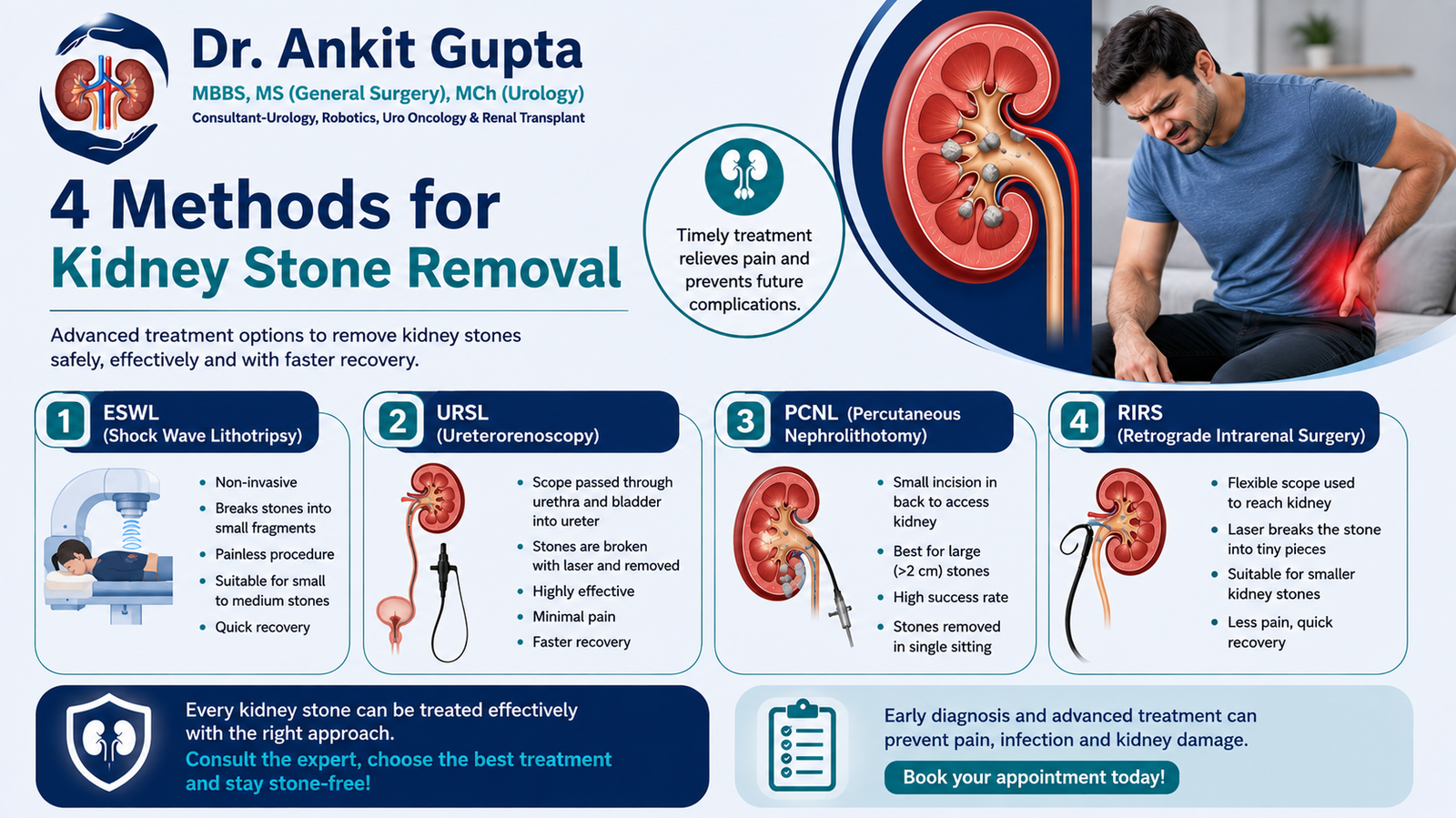
The four primary methods for kidney stone removal depend heavily on the size and location of the stone: natural passing with water and medication for small stones, shock wave lithotripsy (SWL) using sound waves, ureteroscopy with a laser scope, and percutaneous nephrolithotomy (PCNL) for large staghorn or complex stones. Choosing the right treatment depends on your specific medical imaging and symptoms.
When Does a Kidney Stone Need Removal?
Not every kidney stone requires surgery.
Small stones may pass naturally with medication and adequate hydration. However, stone removal may be recommended when:
- The stone is too large to pass naturally.
- Severe pain continues despite medication.
- The stone blocks urine flow.
- There is a urinary tract infection.
- Kidney function is affected.
- Stones keep recurring.
- Blood appears repeatedly in the urine.
1. RIRS (Retrograde Intrarenal Surgery)
What is RIRS?
Retrograde Intrarenal Surgery (RIRS) is a modern, minimally invasive procedure used to treat kidney stones without making any external incision.
A flexible ureteroscope is passed through the natural urinary passage into the kidney, and a laser is used to break the stone into tiny fragments.
When is RIRS recommended?
RIRS may be considered for:
- Small to medium-sized kidney stones
- Stones located inside the kidney
- Patients who prefer a minimally invasive approach
- Patients unsuitable for PCNL in selected situations
The final decision depends on the patient's evaluation by the urologist.
Advantages of RIRS
- No external incision
- Laser-based treatment
- Minimal bleeding in most cases
- Shorter hospital stay in many patients
- Faster recovery for suitable candidates
Recovery after RIRS
Most patients resume light daily activities within a few days, although recovery varies depending on individual health and stone characteristics.
Confused about your symptoms? Get FREE expert advice on WhatsApp now.
2. Laser URSL (Ureteroscopic Laser Lithotripsy)
What is Laser URSL?
Laser URSL is commonly used to remove stones located in the ureter, the tube connecting the kidney to the bladder.
A thin ureteroscope is inserted through the urinary passage, and a laser fiber breaks the stone into smaller pieces that either pass naturally or are removed during the procedure.
When is Laser URSL recommended?
It may be suitable for:
- Ureteric stones
- Stones causing severe pain
- Stones blocking urine flow
- Stones that have not passed with medication
Advantages of Laser URSL
- No external cuts
- High precision
- Effective for ureteric stones
- Faster recovery in many patients
- Short hospital stay for suitable cases
Recovery after Laser URSL
Most patients recover quickly and return to normal activities within a few days, depending on their condition.
3. PCNL (Percutaneous Nephrolithotomy)
What is PCNL?
PCNL is a minimally invasive surgical procedure generally used for large or complex kidney stones.
A small incision is made in the back to create a direct pathway to the kidney, allowing the surgeon to remove or break the stone.
When is PCNL recommended?
PCNL is commonly considered for:
- Large kidney stones
- Multiple stones
- Staghorn calculi
- Stones not suitable for RIRS or URSL
Advantages of PCNL
- Effective for large stones
- High stone clearance rates
- Suitable for complex kidney stones
- One of the standard treatments for larger stone burden
Recovery after PCNL
Recovery may take slightly longer than RIRS or URSL because the procedure involves a small incision, but many patients recover well with appropriate postoperative care.
Get expert advice for kidney stone, prostate & urology problems — FREE
4. Mini PCNL
What is Mini PCNL?
Mini PCNL is an advanced variation of conventional PCNL that uses smaller surgical instruments and a smaller access tract.
It is designed to reduce tissue trauma while effectively removing suitable kidney stones.
When is Mini PCNL recommended?
It may be suitable for:
- Medium-sized kidney stones
- Selected large stones
- Patients who are suitable candidates after evaluation
Advantages of Mini PCNL
- Smaller incision than standard PCNL
- Reduced bleeding in selected patients
- Less postoperative discomfort in many cases
- Shorter hospital stay for suitable patients
- Faster recovery compared to conventional PCNL in some patients
Recovery after Mini PCNL
Many patients experience quicker recovery compared to standard PCNL, although recovery depends on the individual's overall health and stone complexity.
Comparison of the Four Kidney Stone Removal Methods
| Treatment | Best For | Incision | Recovery |
|---|---|---|---|
| RIRS | Small to medium kidney stones | No | Usually quick |
| Laser URSL | Ureter stones | No | Usually quick |
| PCNL | Large or complex kidney stones | Small incision | Moderate |
| Mini PCNL | Medium to selected large stones | Small incision | Often quicker than standard PCNL |
Only Limited Free Consultation Slots Available Today.
Which Kidney Stone Treatment is Best?
There is no single "best" treatment for every patient.
The right option depends on:
Stone Size
Larger stones may require different treatment than smaller stones.
Stone Location
Kidney stones and ureter stones are often managed using different procedures.
Stone Type
Some stone compositions may influence treatment planning and prevention strategies.
Patient's Overall Health
Age, kidney function, infections, previous surgeries, and other medical conditions are also considered before selecting a treatment.
How Does the Doctor Decide the Right Procedure?
Before recommending treatment, your urologist may advise:
CT KUB Scan
To determine the exact size and location of the stone.
Ultrasound KUB
To evaluate the kidneys and urinary tract.
Urine Tests
To check for infection or blood in urine.
Blood Tests
To assess kidney function and overall health.
Confused about your symptoms? Get FREE expert advice on WhatsApp now.
Can Kidney Stones Be Prevented After Removal?
Yes, although recurrence is possible.
To reduce future risk:
- Drink adequate water every day.
- Limit excess salt intake.
- Maintain a healthy weight.
- Follow a balanced diet.
- Manage diabetes and gout if present.
- Follow your doctor's dietary advice based on stone type.
- Attend regular follow-up appointments.
Kidney Stone Removal in Gurgaon
If you have persistent kidney stone symptoms, repeated infections, severe pain, or a stone that is not passing naturally, consulting an experienced urologist is important.
Dr. Ankit Gupta, Urologist in Gurgaon, provides comprehensive evaluation and advanced kidney stone treatment using modern minimally invasive procedures such as RIRS, Laser URSL, PCNL, and Mini PCNL. The treatment plan is individualized based on the stone size, location, patient health, and diagnostic findings.
Get expert advice for kidney stone, prostate & urology problems — FREE
Frequently Asked Questions (FAQs)
Which is the best method for kidney stone removal?
There is no one-size-fits-all answer. The best treatment depends on the stone's size, location, and the patient's overall condition.
Is kidney stone surgery always necessary?
No. Many small stones may pass naturally with medication and hydration. Surgery or procedures are recommended only when medically indicated.
Which procedure is used for ureter stones?
Laser URSL is commonly used for stones located in the ureter, although treatment decisions depend on individual circumstances.
Which treatment is preferred for large kidney stones?
PCNL or Mini PCNL may be recommended for larger or complex stones after evaluation by a urologist.
Is RIRS a minimally invasive procedure?
Yes. RIRS is performed through the natural urinary passage without an external incision.
How long does recovery take after kidney stone removal?
Recovery varies depending on the procedure performed, the size of the stone, and the patient's overall health.
Can kidney stones come back after treatment?
Yes. Kidney stones can recur. Lifestyle changes, dietary modifications, and regular follow-up may help reduce the risk.
Our Treatments
- Kidney Stone Treatment
- Prostate Enlargement Treatment
- Kidney Transplant Surgery
- Kidney Cancer Treatment
Only Limited Free Consultation Slots Available Today.
Other Blogs
- पेशाब में खून आना क्यों होता है?
- कमर में तेज दर्द क्या Kidney Stone का संकेत है?
- Kidney Stone के सबसे बड़े कारण क्या हैं?
- क्या Kidney Stone अपने आप निकल सकता है?
- क्या बच्चों को Kidney Stone हो सकता है?
-
पेशाब में जलन: कारण, लक्षण, घरेलू उपाय और इलाज
-
पुरुषों में सेक्स की इच्छा कम क्यों हो जाती है? कारण, लक्षण और इलाज
Conclusion
Modern kidney stone treatment has become much safer and less invasive than in the past. RIRS, Laser URSL, PCNL, and Mini PCNL are among the most effective procedures available today, each designed for different types and sizes of kidney stones. The ideal treatment depends on a detailed medical evaluation rather than the stone size alone. If you are experiencing severe pain, blood in urine, recurrent infections, or have been diagnosed with a kidney stone, early consultation with a qualified urologist can help determine the most appropriate treatment and reduce the risk of complications.