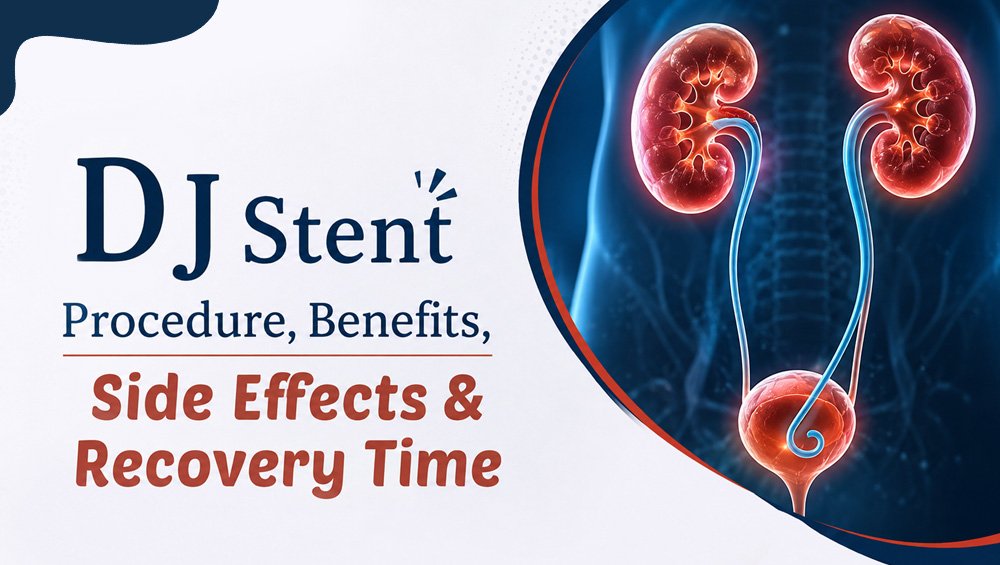
A DJ stent (double-J or ureteral stent) is a thin, flexible plastic tube placed inside the body to help urine drain from the kidney into the bladder when the natural pathway is blocked or healing.
What is a DJ Stent?
A DJ stent is known as a double J stent, too. A DJ stent is a long, thin tubular stent facilitating the flow of urine from the kidney to the bladder. They are referred to as double J stents as both ends are curled in a J shape. DJ stents fully occupy the kidney for one end to remain inside the organ, with the other end inside the bladder.
The purpose of the stent is to make urine flow from the kidney to the bladder, especially when the ureters are blocked. Increased ureter swelling may lead to additional obstruction from kidney stones, inflammatory swelling, or surgical swelling of the tract. This may cause the kidney to be blocked, increasing swelling.
Why is a DJ Stent Used?
Several urinary tract conditions may prompt doctors to recommend a DJ stent. A common example includes kidney stones. When stones become too large, they may block urine flow. This becomes very painful and may even result in swelling and infection in the kidney.
DJ stents are also used to keep the ureter open during the healing process after kidney stone surgeries. Sometimes, the stent is needed because urine may be temporarily blocked due to swelling/inflammation in the ureter.
DJ stents can also be used in the following scenarios:
- Urinary blockages due to infections
- Stenosis of the ureter
- Inflammation following urologic surgeries
- Preserving kidney functionality during other treatments
The stent is designed to keep urine flowing and prevent kidney damage.
Confused about your symptoms? Get FREE expert advice on WhatsApp now.
DJ Stent Procedure – Step-by-Step
The DJ stent procedure is fast and easy. No major cuts are made, and no major sutures are needed. Anesthesia is used to perform the procedure.
Before the Procedure
Before the stent placement, blood, urine, and workflows to check the urinary system may be ordered to be done. There’s also a chance the patient will have to fast for a few hours before the procedure.
During the Procedure
The doc performs the ureter and bladder junction using a cystoscope, and a double D stent is placed to drain urine in the body. Since this is all internal, it minimizes time.
After the Procedure
Patients are monitored post-procedure in the hospital for a few hours, and depending on the case, overnight stays may be necessary. Some will be able to go directly home.
The stent is placed temporarily to be removed in a simple outpatient procedure later, and to aid in the recovery of the urinary system.
Benefits of the DJ Stent
For painful kidney stones or urinary system blockages, patients can also experience relief with a DJ stent. Here’s a breakdown of stent benefits.
1. Alleviates Urine Obstructions
The urethral stent has an open channel, improving the kidney-to-bladder flow.
2. Reduces Pain & Pressure
Kidney internal blockage can be painful due to the rising pressure. A urethral stent improves comfort with reduced pressure.
3. Prevents Long-term Damage
Blockages can reduce kidney functionality, leading to lasting detriment. A stent restores urinary flow which, in turn, helps to mitigate potential damage.
4. Aids Healing
Post-operation, the urethra can be inflamed and in need of healing. A stent can help with both.
5. Relieves Symptoms
Patients experience a high quality of symptom relief that can be taken for granted with normal urinary flow restoration.
Get expert advice for kidney stone, prostate & urology problems — FREE
Common DJ Stent Side Effects
While procedures are safe, risks like DJ stents' side effects are temporary. These symptoms may last while the stents are inside the body.
Frequent Urination
Stents can irritate and lead to a feeling of more frequent urination.
Burning Sensation During Urination
While stents are present, a burning sensation and discomfort may transiently occur.
Blood in Urine
Blood in urine, especially post-activity, can be expected.
Lower Abdominal Discomfort
Patients can expect to feel discomfort and irritation of a transitory nature in the lower abdominal region.
Back Pain During Urination
Urine can backflow to the kidney post-stent and cause some back pain during urination.
Symptoms are usually mild. If back pain, fever and bleeding occur, be sure to seek medical attention.
Recovery Time After DJ Stent Placement
The DJ stent recovery time depends on the individual and why the stent was placed. Most patients are back to their regular daily routine in a couple of days.
There may be mild pain, a burning sensation or a frequent feeling that you need to urinate, but these go away eventually.
Patients should try to:
- Be well-rested by hydrating daily
- Lift less for some days
- Take meds on schedule
- Don’t hold back when you need to urinate
- Come to the doctor’s for checkups
Stents are made to be removed after a designated time. Keeping them in for longer than they are made to be may cause them to get infected and cause other problems.
Only Limited Free Consultation Slots Available Today.
When Should You Contact a Urologist Immediately?
Mild symptoms following stent placement are normal, but some signs require immediate medical attention. A urologist plays an important role in preventing complications, protecting kidney function, and ensuring smooth recovery after stent placement.
You should see a urologist right away if you have:
- Pain that is severe or worsening
- Heavy bleeding in urine
- Increased nausea or vomiting
- Difficulty urinating
- Vomiting that won’t stop
- Signs of infection, including fever or chills
Timely consultation with an experienced specialist like Dr. Ankit Gupta, Best Urologist in Gurgaon, can help identify complications early and ensure proper treatment before the condition becomes serious. Getting medical care quickly can help you recover safely and avoid long-term problems.
Conclusion
A DJ stent procedure is reliable, safe, and widely performed as a treatment for kidney protection by relieving a urinary obstruction. A double J stent is used to promote the recovery of urinary flow after a treatment that resolves kidney obstructions caused by swelling, urinary obstruction, or kidney stones.
A DJ stent may have symptoms of discomfort and increased urination. These side effects will diminish in time, and follow-up should be done to remove the stent as per the time frame prescribed to achieve maximum recovery benefit.
For severe urinary blockage, stent placement, kidney stones, and obstruction symptoms, consult Dr. Ankit Gupta, Best Urologist in Gurgaon, for advanced and reliable urological care solutions.